Astraware Wordsearch
Astraware LimitedWord
4.560.00 Reviews
- Version
- 2.93.002
- Installs
- 10.00K
- Age Rating
- Everyone
Screenshots
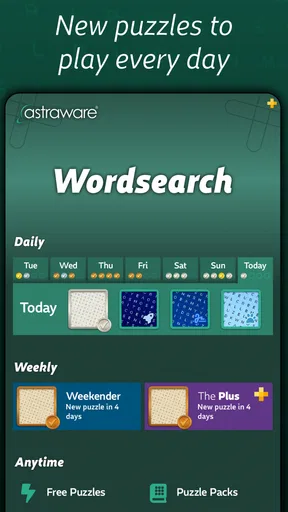
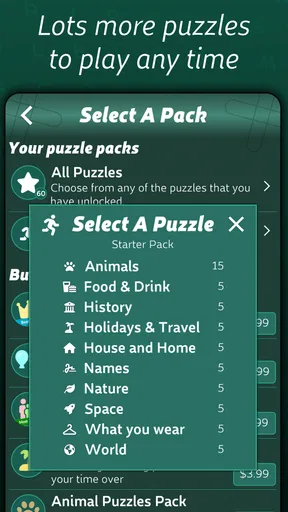
Our Review of Astraware Wordsearch
 Analysis by Appyee
I opened Astraware Wordsearch expecting a straightforward word puzzle, and that is exactly what I found: a focused game built around spotting hidden words quickly. Its appeal is not a large story, a complicated progression system, or a dramatic setting. Instead, it creates a small, repeatable challenge that works well when I want to exercise my attention for a few minutes without learning a complicated rule set.
The game comes from Astraware Limited and sits firmly in the word-game category. It is free to start, carries an Everyone age rating, and is available for devices running at least iOS 9. The current version is 2.93.002, so the product has had time to settle into its basic identity rather than feeling like an unfinished experiment. Its average rating is 4.5 from around 410 ratings, and it has passed 10 thousand installs, which gives me a useful sense of its audience without changing the more important question: whether its particular style suits the way you like to play.
A calm word hunt with a clear visual identity
I like how Astraware Wordsearch makes its visual simplicity part of the appeal: the grid, rather than a busy backdrop, holds my attention. That also makes the game easy to dip into when I have only a short break, though I find it works best when I can give the letters a little focus. The next section looks at how that restrained presentation shapes the feel of a puzzle.
The first few puzzles explain the game quickly
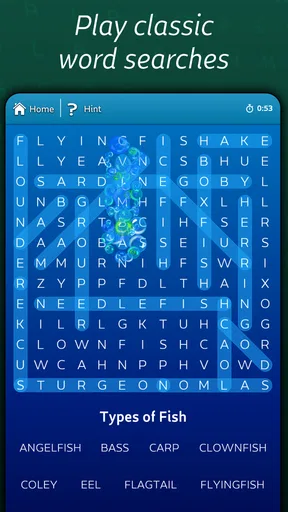
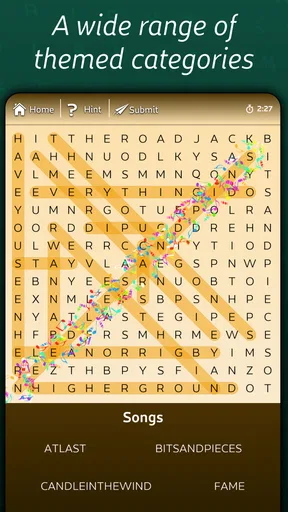
My first impression was that the design stays out of the way of the central activity. You look at a field of letters, search for the target words, and try to find them in a fast time. There is no need to decode a complicated interface before playing. That simplicity is valuable for a wordsearch game because every decorative element competing with the letters can become a distraction.
The visual language feels more like a traditional puzzle book brought to a phone than a colorful arcade production. That is a strength for players who want concentration rather than spectacle. The board itself becomes the setting: rows and columns form a quiet space where the eye moves, tests patterns, and gradually narrows down possibilities. I found that this restrained presentation supports the mood of the game better than an overloaded interface would.
It is also a good fit for casual use. I can imagine opening it while waiting for an appointment, taking a short break from work, or sharing a puzzle with someone who does not normally play mobile games. Because the rules are familiar, the game does not demand a tutorial-heavy introduction. A child, an older relative, or a regular puzzle fan can understand the basic objective almost immediately.
That accessibility should not be confused with a lack of challenge. The goal is not simply to locate words eventually; it is to find them efficiently. The time pressure changes the way I scan the board. I am not reading every letter carefully from left to right. I am looking for likely starting letters, checking common letter combinations, and switching direction when a promising line fails.
How the board creates its own atmosphere
The setting is abstract, but it still has a recognizable mood. There is something pleasantly contained about a letter grid. Unlike a word game that asks me to build words from a changing rack, this format gives me a fixed visual landscape and asks me to explore it. The board feels like a quiet desk puzzle, with the excitement coming from recognition rather than movement or combat.
That atmosphere is coherent because the presentation supports the pace of thought. I do not feel pushed into frantic tapping from the first second, yet the fastest-time objective gives each round a reason to matter. The tension is modest but real: I may know the word I need, but finding its exact path through similar letters takes concentration.
One useful way to approach the game is to treat the grid as a set of visual routes rather than as a wall of individual characters. I first scan for unusual letters, then trace outward in the likely directions. This is faster than attempting to read every row as if it were a sentence. On a small screen, that method also reduces the chance of losing my place after a mistaken search.
The trade-off is that players looking for a strong narrative world will not find one here. There are no characters or story stakes shaping the mood. The game’s identity comes from the physical feeling of searching, the neatness of the board, and the satisfaction of completing a visual task. For me, that is enough for short sessions, but it may feel bare if you need a richer setting to stay engaged.
Sound and rhythm matter even in a quiet puzzle
Wordsearch games do not usually depend on music or elaborate sound design, and this one is best understood through its rhythm rather than through a dramatic audio presentation. The important rhythm is the cycle of scanning, recognizing, selecting, and moving on. A good round gives me a steady flow: I spot one answer, gain confidence, and use that momentum to locate the next.
That rhythm works especially well when I play in short bursts. I do not need to reserve a long session or remember a complex storyline. The game can sit beside my daily routine as a small concentration exercise. It is suitable for a quiet commute or a break, although I would be careful with the speed-focused objective in situations where I need to pay attention to my surroundings.
The absence of a large audiovisual spectacle is also part of the game’s personality. It keeps the focus on the letters and makes the experience less tiring than many mobile games that constantly animate the screen. If you prefer games that reward you with loud effects, elaborate transitions, or a strong musical identity, this may seem understated. If you prefer a calm puzzle that lets you think, the restraint is more likely to help.
I also appreciate that the pacing comes from the player rather than from a stream of forced events. I can search methodically when I am tired, or try to improve my speed when I am alert. That flexibility gives the same basic mechanic more than one use: it can be a relaxing visual exercise or a small personal challenge.
Why the simple mechanic holds up
The central mechanic is easy to describe, but it has more depth than simply tapping words. Every grid asks me to manage attention. I need to decide whether to search horizontally, vertically, or diagonally, and I need to recognize that a word may be easier to find by its rare letter than by its first letter. The best moments come when a pattern suddenly becomes visible and the whole answer seems to emerge from the surrounding noise.
The fastest-time focus gives the game a clear measure of improvement without requiring a complicated scoring system. I can replay with a different strategy: scan the edges first, search for longer-looking sequences, or prioritize words containing unusual combinations. These are small adjustments, but they make repeat play more active than simply repeating the same routine.
One practical tip is to avoid dragging or selecting too quickly before confirming the full route. A rushed gesture can make me lose time if I begin from the wrong letter. I get better results by identifying a likely anchor letter, tracing the word mentally, and then marking it in one deliberate motion. On a phone, that balance between speed and accuracy is more important than raw tapping speed.
Another useful habit is to change the scale of my attention. I begin with a broad scan to locate clusters that look promising, then zoom my focus onto a small area of the grid. Staring at the entire board continuously is tiring and can make obvious words disappear into visual clutter. Alternating between broad and narrow searches keeps the process clearer.
The game is a particularly good match for people who enjoy paper wordsearch books but want something more portable and time-oriented. Compared with a crossword, it asks less of my vocabulary and more of my visual tracking. Compared with a word-building game, it does not ask me to invent answers from available letters. Compared with a timed arcade puzzle, it is quieter and more deliberate. Those differences make the choice fairly simple: select this style if finding patterns appeals to you more than constructing words or solving clues.
Where the free model fits into the experience
The game is free, which makes it easy to try without committing money first. There are in-app purchases ranging from $0.99 to $7.99 per item. I would approach those purchases as optional support or convenience rather than as the reason to install the game. The important test is whether the basic wordsearch experience already fits your habits before you spend anything.
This model is sensible for a casual puzzle, but it is still worth considering how often you expect to play. Someone who only wants an occasional grid may never feel a need to buy anything. A dedicated player who returns regularly may view optional purchases differently, especially if they want to extend the experience. Either way, I would make the decision after trying the free version rather than assuming that a purchase is required for the game to be worthwhile.
There is also a broader trade-off between this focused design and more feature-heavy word games. Other alternatives may offer daily challenges, elaborate progression, multiplayer competition, or broader word-building systems. Those features can provide stronger long-term goals, but they can also make a short session feel more demanding. Astraware’s approach is better when I want to start playing immediately and keep my attention on one task.
Who will enjoy it, and who should skip it
I would recommend it to people who like hidden-word puzzles, visual pattern recognition, and quick sessions with a clear objective. It is also a reasonable choice for families because the Everyone rating and familiar rules make the premise approachable. Players who enjoy improving personal speed can find a small but satisfying challenge in repeating the same kind of search with sharper technique.
I would be less likely to recommend it to someone who needs a strong sense of progression. If you want a role-playing layer, a story campaign, or a constantly changing set of mechanics, this game may feel too narrow. It is also not the ideal option for players who dislike time-oriented goals. Even though the activity can be played calmly, the fastest-time emphasis naturally encourages comparison with your own previous performance.
People with visual fatigue should think about session length. A dense letter grid requires sustained scanning, and the very feature that makes the game engaging can become tiring after a long period. I find it better in compact sessions, with a pause between rounds, than as a game to leave open for hours.
Small strategies that make a real difference
The most effective improvement I found was to stop treating every word as equally difficult. Short, familiar words can be hidden in ways that are easy to overlook because my eyes expect them to be part of a longer sequence. I check those compact answers deliberately rather than assuming the longer words deserve all my attention.
I also use the word list as a planning tool instead of merely as a checklist. If one answer contains a rare letter, I search for that letter first. If several targets begin with the same letter, I look for their second or third letters before tracing a full line. This reduces random scanning and turns the board into a set of manageable hypotheses.
A final tip is to protect the rhythm of a successful search. After finding a word, I do not immediately jump to the opposite corner without looking at the nearby letters. The eye is already focused on that region, and another answer may be close. Later, I make a deliberate sweep of the areas I have ignored. This two-stage approach feels faster and less frustrating than moving randomly after every discovery.
My overall view of the mood and mechanics
Astraware Wordsearch succeeds because its art direction, setting, and pacing all serve the same modest purpose: creating a clean space for visual word hunting. It does not pretend to be a large adventure, and I think that honesty helps. The game gives me a familiar activity with enough time-based pressure to stay engaging, while remaining calm enough for everyday use.
Its limitations are equally clear. The abstract setting will not satisfy players who need story or character, and the focused mechanic may become repetitive for anyone seeking constant novelty. The free entry point is helpful, while the optional in-app purchases mean regular players should decide how much they want to invest after understanding their own usage.
For me, the strongest reason to try it is the balance between immediate accessibility and small opportunities for mastery. I can play without preparation, but I can also refine how I scan, choose anchor letters, and control my gestures. That makes it more rewarding than a completely passive time filler.
If you want a portable wordsearch with a quiet visual mood, a clear objective, and enough pacing to make speed matter, I think it is worth trying. If your ideal word game depends on clues, word construction, multiplayer competition, or a rich fictional world, another category will serve you better. For the right player, Astraware Wordsearch is a compact concentration game that turns a familiar paper puzzle into a practical mobile habit.
As a free game from Astraware Limited, it is easy to approach, and its Everyone rating makes it broadly accessible. I would install it for short breaks, relaxed family play, or a focused attempt to improve my search time. I would not choose it as my only word game, but I would gladly keep it available for those moments when I want a quiet challenge that begins instantly and ends with the satisfying feeling of having found every hidden answer.
Verdict
Strengths of Astraware Wordsearch
- Large collection of wordsearch puzzles for varied play sessions.
- Adjustable difficulty suits both casual players and puzzle fans.
- Clear, readable layout makes letters easy to scan.
- Offline play is convenient when traveling or without internet.
- Relaxed gameplay offers a low-pressure way to exercise vocabulary.
Limitations of Astraware Wordsearch
- Some puzzles may feel repetitive after extended play.
- Small screens can make dense letter grids harder to navigate.
- Hints or extra content may be limited by the version installed.
- Players seeking fast action may find the pace too slow.
- The visual style may seem dated compared with newer puzzle apps.
Other Releases by Astraware Limited
View All
Astraware Acrostic
Word4.4
Similar Picks in This Category
View All
Word Search - Word Puzzle Game
Bluetile4.8

Word Search Quest - Puzzles
Blackout Lab4.8

CodyCross: Crossword Puzzles
Fanatee, Inc.4.7

Words of Wonders: Crossword
Fugo Games4.9

Wordscapes: Word puzzle game
PeopleFun4.7

Word Search Explorer
PlaySimple Games4.9
Frequently Asked Questions
What is Astraware Wordsearch?
Astraware Wordsearch is a word puzzle game for Android and iOS in which you search for hidden words inside letter grids. It is designed for casual play, with themed puzzles and a straightforward interface that makes it easy to start a game quickly. The app is suitable for players who enjoy relaxing vocabulary challenges rather than fast-paced action or complicated game mechanics.
How does the gameplay in Astraware Wordsearch work?
Each puzzle presents a grid filled with letters and a list of words to find. Words may appear horizontally, vertically, diagonally, or in reverse directions, so scanning the board carefully is important. When you locate a word, you generally swipe across the letters to mark it as completed. The game then tracks your progress until the full list has been discovered.
Is Astraware Wordsearch suitable for beginners and children?
The game is generally approachable for beginners because its controls are simple and the main objective is explained through the puzzle itself. However, difficulty can vary depending on the word list, grid size, and theme. Parents should review the app’s age rating and available content before giving it to younger children, especially if advertising, purchases, or online features are present in their version.
Does Astraware Wordsearch require an internet connection?
Many wordsearch puzzles can typically be played without a constant internet connection once the application and its content are installed. This makes it convenient for travel, commuting, or short offline sessions. Nevertheless, an internet connection may still be needed for downloading additional puzzles, receiving updates, displaying advertisements, restoring purchases, or accessing any online functionality included in the version available on your device.
Is Astraware Wordsearch free to download, and does it include in-app purchases?
Availability and pricing may differ between the Google Play Store and Apple App Store, so you should check the current listing before downloading. Some editions may be paid, while others can be free with advertising or optional purchases. Review the store description carefully for information about ads, premium puzzle packs, subscriptions, and other payments so you understand the full cost before installing the game.
Play our best games!


